


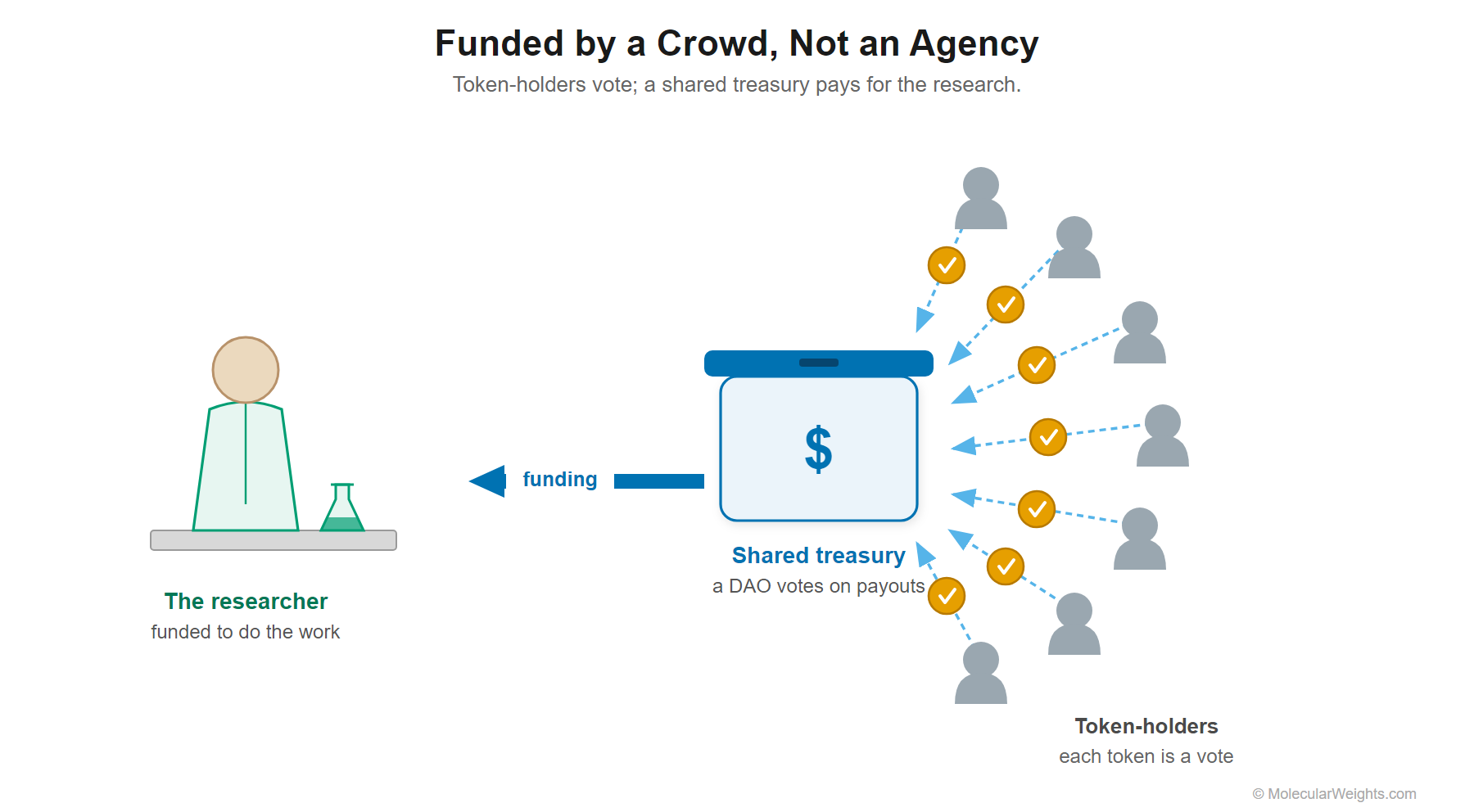
Figure 1. In DeSci, a shared treasury pays for the research, and the people holding its tokens vote on what it funds. The grant agency in the middle is replaced by a crowd.
Picture a biologist with a promising idea about why cells age. She does not write a grant to the National Institutes of Health and wait eighteen months. She does not sign her eventual paper over to a journal that will sell it back to her university. Instead, a few thousand strangers holding a digital token read her proposal, vote to fund it from a shared pool of money, and take a stake in whatever intellectual property comes out the other end.
That scene is not hypothetical. It is roughly how VitaDAO, a community that funds longevity research, already operates. And it captures what the decentralized science movement, “DeSci” for short, is trying to make ordinary.
In two earlier pieces we laid out the problem DeSci thinks it can solve. Part 1 followed the money through academic publishing, where five companies control more than half the literature and post profit margins above 35% on content they neither create nor check. Part 2 traced the damage and the diagnosis: the system holds because careers are wired to journal prestige, so no single researcher can afford to walk away. DeSci’s answer is blunt. Stop trying to reform the building. Leave it.
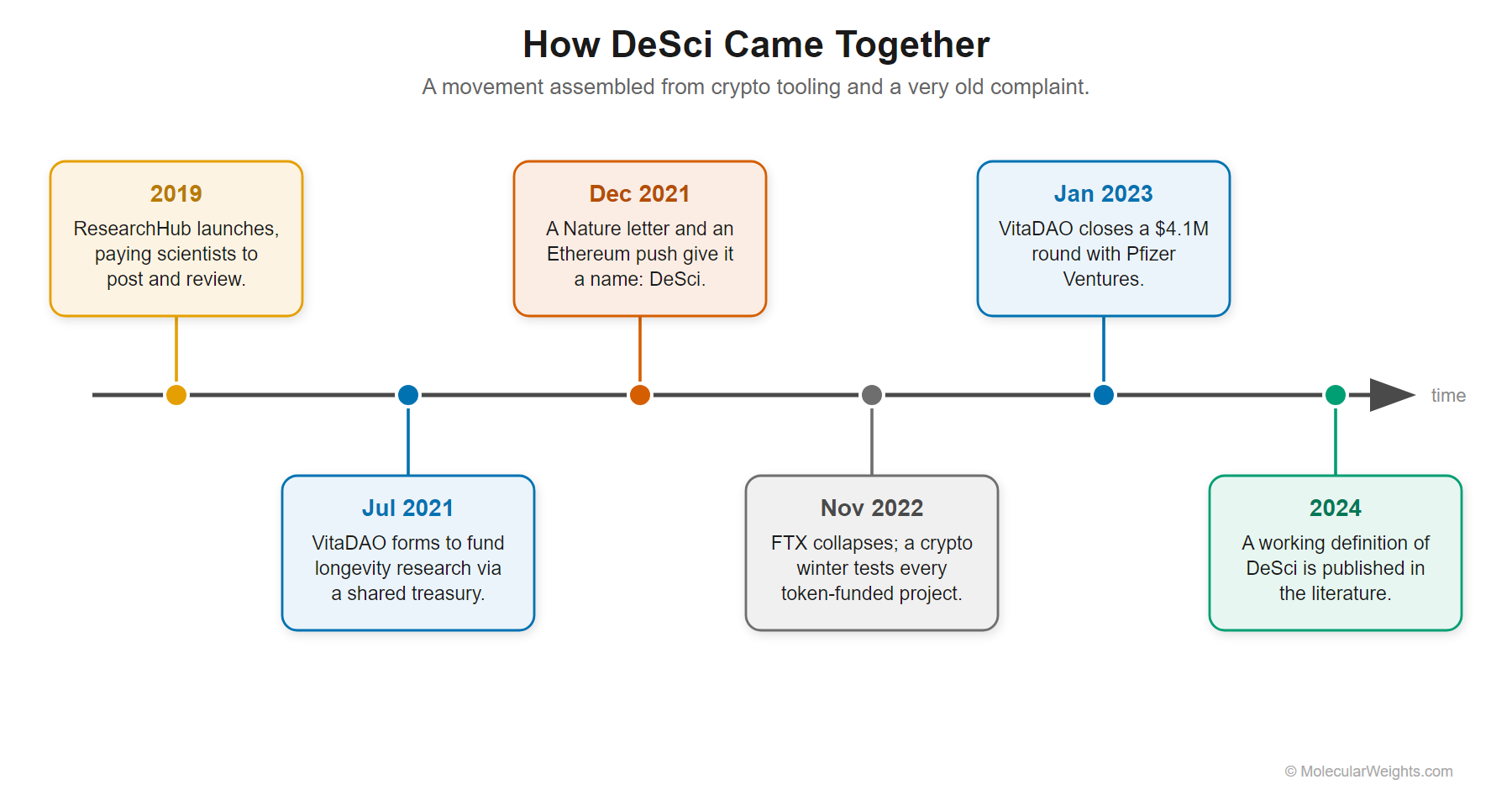
Figure 2. How DeSci came together, 2019 to 2024. The movement assembled from existing crypto tooling and a long-standing complaint about who controls research money. Milestones are shown in order, not to scale.
What DeSci Actually Is
Ask ten people in the movement what decentralized science means and you get ten answers. That is not a figure of speech. When Lukas Weidener and Cord Spreckelsen surveyed 39 active DeSci participants for a 2024 review in Frontiers in Blockchain, they found no agreed definition, just a recurring cluster of values, with transparency and openness named by 92% of respondents.1 The label is younger than the parts it describes. ResearchHub was already paying people in tokens to review papers in 2019. The word “DeSci” showed up later, in December 2021, when the neuroscientist Sarah Hamburg published a one-paragraph letter in Nature urging researchers to join a movement aimed at science’s “pain points, silos and bottlenecks.”2 It came out of the Ethereum crowd, people who had spent years building financial tools on public blockchains and turned to ask why research still ran on subscriptions and gatekeepers.
The pitch underneath the vocabulary is plain. Use shared, public software to fund research, review it, credit the people who do the work, and publish the results, with no company in the middle taking a cut and setting the rules. The Ethereum Foundation frames the goal as public infrastructure to fund, create, review, and share knowledge “fairly and equitably.”3 What that looks like once you open the hood is the part worth slowing down on.
The Machinery, in Plain Language
Four pieces do the work, and the vocabulary is scarier than the ideas.
A DAO, or decentralized autonomous organization, keeps a group’s money and decisions on a blockchain instead of inside a company. Members hold voting shares called governance tokens. To fund a project or change a rule, holders vote, and the software executes the outcome. No chief executive signs off. The tally does.
The third piece is the odd one, and the one that makes the rest matter: the IP-NFT. A patent or a licensing agreement gets wrapped into a token that records who owns it and on what terms.3 That token can be sold, split among funders, or held as the asset a DAO invests in. When VitaDAO backs an aging study, it is usually buying an IP-NFT, so the people who paid for the science hold a claim on whatever it produces.
Last is on-chain peer review. Reviews get logged publicly and permanently, so the unpaid, invisible labor that Part 2 valued in the billions can be credited on a CV and, in some designs, paid in tokens. Tenorio-Fornés and colleagues built and tested a working prototype of exactly this back in 2021.4 The engineering turned out to be the easy half, a point that comes back to bite later.
Put the four together and you have, in theory, a replacement for the entire publishing stack. A 2022 paper in IEEE Transactions on Computational Social Systems drew the full blueprint, a reference model for a start-to-finish decentralized system.5 On paper it is coherent. Whether it runs is a separate question.
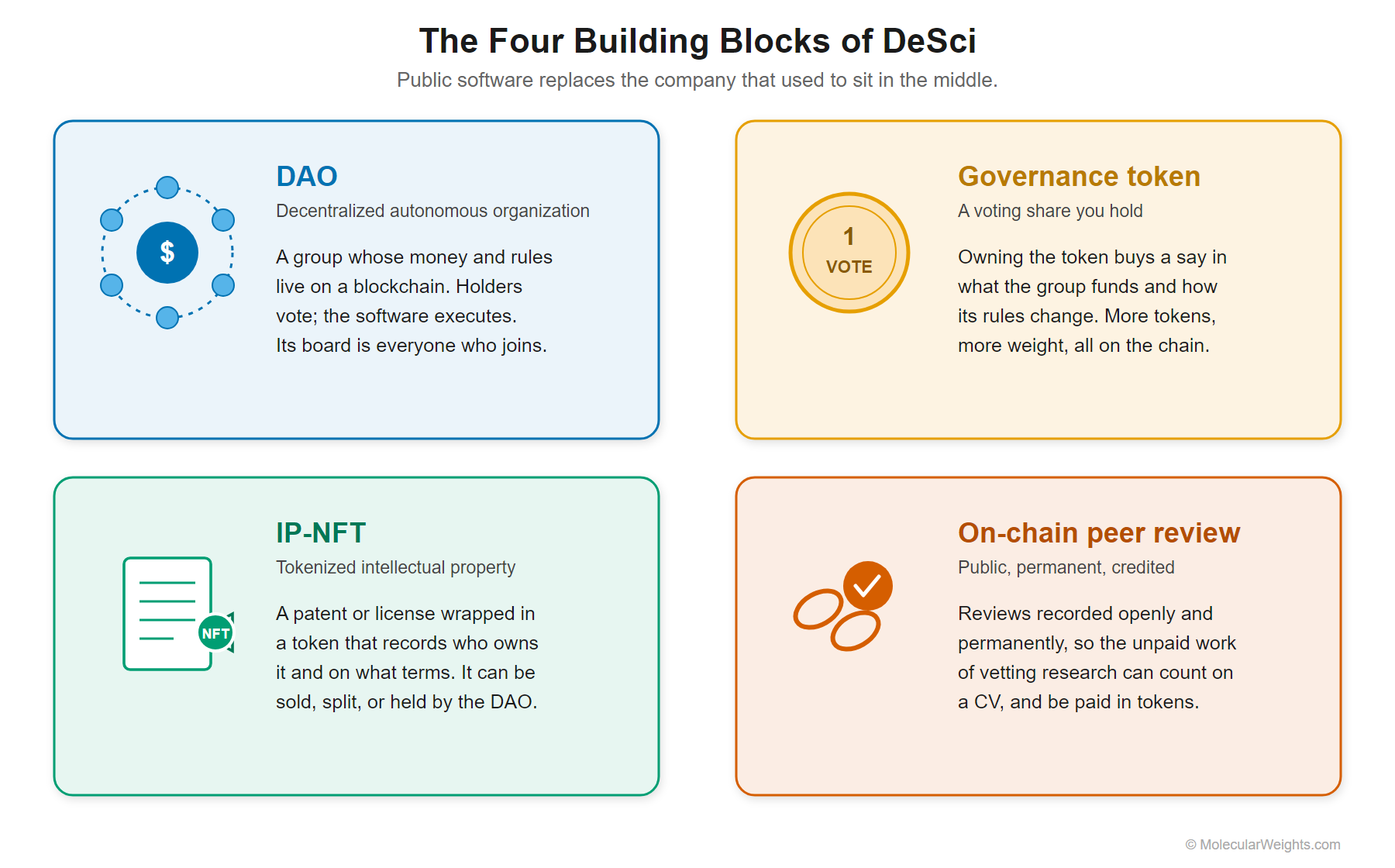
Figure 3. DeSci’s four building blocks. A DAO is a blockchain-run organization whose token-holders vote on funding; a governance token is that voting share; an IP-NFT wraps a patent or license into a tradable token; on-chain peer review records reviews publicly so the work can be credited. Concepts adapted from ethereum.org/en/desci.
Who Is Actually Doing This
VitaDAO is the one people point to first. It launched in July 2021 to fund early-stage longevity research that venture capital treats as too speculative to touch. Members vote on which aging studies to back and hold VITA tokens that carry a say over the treasury. In January 2023 it closed a $4.1 million round that included Pfizer Ventures, making Pfizer the first major drug company to put money into a DeSci group and vote on its proposals.6 A drug company sitting on a blockchain committee is not a sentence anyone was writing in 2019.
Molecule is the layer underneath. It runs the IP-NFT marketplace that connects biotech researchers with funders, and several biotech DAOs, VitaDAO among them, are built on its rails.3 Strip out that plumbing and the tokens the others trade have nothing standing behind them.
ResearchHub works the far end of the pipeline, where results get shared and reviewed. Coinbase chief executive Brian Armstrong and Patrick Joyce founded it in 2019, and it pays users in ResearchCoin for uploading papers, curating them, and writing reviews.7 Armstrong calls the goal a “GitHub for science,” a place where the work of vetting research earns visible, portable credit instead of a thank-you email.
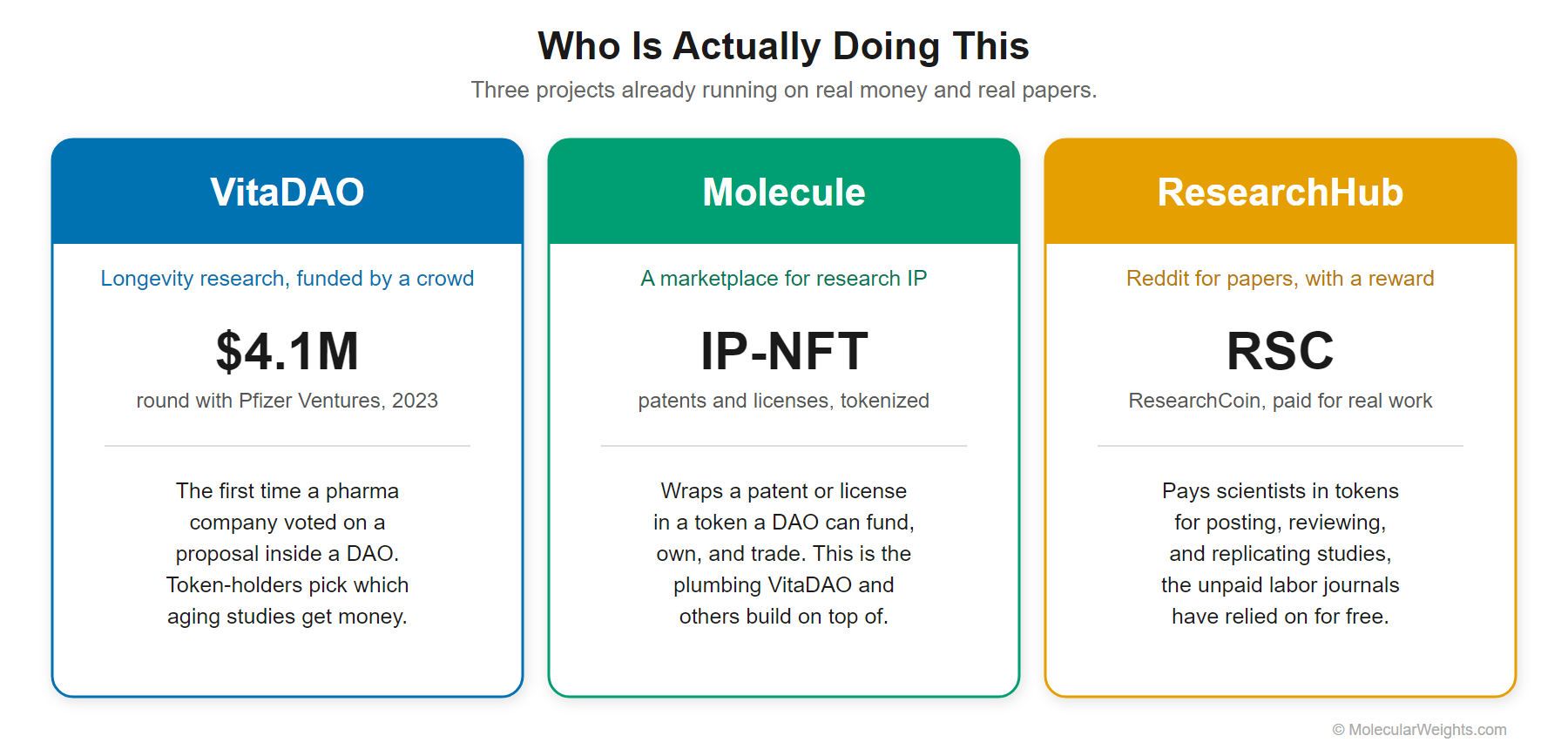
Figure 4. Three DeSci projects already running on real money and real papers. VitaDAO funds longevity research and closed a $4.1M round with Pfizer Ventures in 2023, the first time a pharma company voted on a DAO proposal. Molecule runs the IP-NFT marketplace that wraps patents and licenses into tradable tokens. ResearchHub pays scientists in ResearchCoin for posting, reviewing, and replicating work.
The Part That Does Not Work Yet
DeSci is welded to cryptocurrency, and crypto spent 2022 setting itself on fire. When the FTX exchange collapsed that November, it took fortunes and most of the public trust in anything token-shaped down with it. A Nature Biotechnology feature from that year caught the tension neatly: scientists were genuinely curious about decentralized funding, but crypto’s “checkered reputation” made universities and cautious funders reluctant to go near it.8 A treasury that can lose half its value in a bad week is a hard pitch to a lab trying to make payroll.
The legal picture is no clearer. Nobody can say for certain how a tokenized patent is taxed, who is liable when a DAO’s smart contract misfires, or whether a governance token counts as an unregistered security. Not fatal questions. Unanswered ones, and unanswered questions keep cautious institutions on the sidelines.
Then there is the wall Part 2 spent its whole length on, the one no smart contract touches. Hiring committees and tenure boards still count publications in prestigious journals. A paper funded by a DAO and reviewed on-chain does nothing for a postdoc whose search committee has never heard of the venue and wants a Nature line on the CV. Remember that prototype peer-review system that worked? Its authors hit this exact wall from the other side and concluded the obstacle was never the technology. It was getting scientists to adopt a venue their institutions did not recognize.4 You can build the better pipe and still watch the water pool at the mouth, because the people who decide careers are not looking at the pipe. They are looking at the masthead.
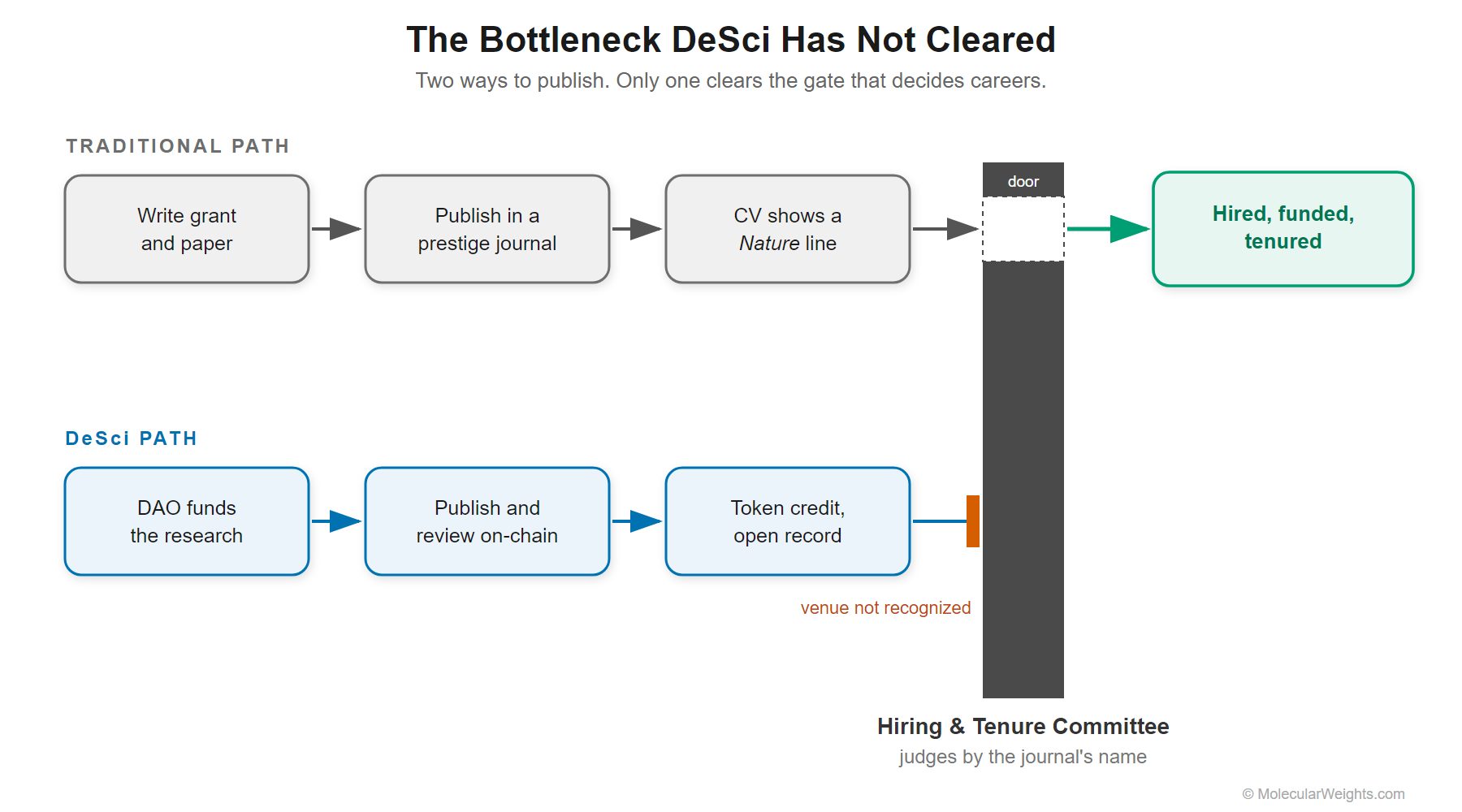
Figure 5. The bottleneck DeSci has not cleared. Both paths produce published, reviewed work, but only the traditional path clears the hiring-and-tenure gate that still judges by the journal’s name. Until that changes, a better pipeline changes less than its builders hope.
Did You Know?
· VitaDAO’s members vote on which aging experiments to fund, and Pfizer Ventures bought in as a token-holding participant rather than a traditional investor, which means a pharmaceutical giant now casts votes alongside anonymous longevity enthusiasts.
· An IP-NFT can carry the actual legal terms of a research agreement inside the token itself, so transferring a patent can, in principle, be as quick as sending a file.
· The word “DAO” describes an organization with no chief executive and no headquarters. Its bylaws are software, and its board is whoever holds the tokens.
Why It Matters Now
The publishing machine took fifty years and a long run of quiet mergers to become what it is. DeSci is about four years old and still arguing with itself over what it even is, as that survey of 39 practitioners made plain.1 Set against the incumbent, it is small and unproven at scale.
Scale is the wrong test this early, though. DeSci matters because it is the first serious attempt to rebuild how science gets funded and vetted from the ground up, instead of haggling for gentler terms inside a system almost everyone calls broken. The experiments are real. Money is indeed moving. Even Pfizer showed up. Credited, paid peer review is no longer a proposal in a slide deck; it runs today, which is more than the reform campaigns of the past decade could say.
What happens next does not turn on the software but turns on a committee. The day universities and funders start judging the research instead of the letterhead it arrived on, platforms like these suddenly have somewhere to stand. Until that day, DeSci stays a fascinating parallel world that the researchers who would benefit most cannot yet risk to live in.
References
1. Weidener, L., and Spreckelsen, C. “Decentralized science (DeSci): definition, shared values, and guiding principles.” Frontiers in Blockchain 7 (2024): 1375763. doi:10.3389/fbloc.2024.1375763
2. Hamburg, S. “Call to join the decentralized science movement.” Nature 600 (2021): 221. doi:10.1038/d41586-021-03642-9
3. Ethereum Foundation. “Decentralized science (DeSci).” ethereum.org, 2024. ethereum.org/en/desci
4. Tenorio-Fornés, A., Pérez Tirador, E., Sánchez-Ruiz, A. A., and Hassan, S. “Decentralizing science: Towards an interoperable open peer review ecosystem using blockchain.” Information Processing & Management 58 (6) (2021): 102724. doi:10.1016/j.ipm.2021.102724
5. Ding, W., Hou, J., Li, J., Guo, C., Qin, J., Kozma, R., and Wang, F.-Y. “DeSci Based on Web3 and DAO: A Comprehensive Overview and Reference Model.” IEEE Transactions on Computational Social Systems 9 (5) (2022): 1563–1573. doi:10.1109/TCSS.2022.3204745
6. CoinDesk. “VitaDAO Closes $4.1M Funding Round With Pfizer Ventures for Longevity Research.” CoinDesk, January 30, 2023. coindesk.com
7. ResearchHub Foundation. “ResearchCoin (RSC): what it is and how it works.” docs.researchhub.com, 2024. docs.researchhub.com
8. DeFrancesco, L., and Klevecz, A. “Decentralized investor communities gain traction in biotech.” Nature Biotechnology 40 (2022): 1310–1315. doi:10.1038/s41587-022-01459-z