


This is the conclusion of a two-part series. Part 1, “Academic Publishing’s $28 Billion Business Model (Part 1),” explains how the system was built and where the money flows.
Part 1 of this series mapped the machine. Five companies now publish more than half of all peer-reviewed scientific literature.1 Peer reviewers contributed over 100 million hours of unpaid labor in 2020. The salary-equivalent value of that time exceeded $1.5 billion in the US alone.2 Elsevier’s profit margins have run above 35% for years. These margins are sustained because the core intellectual content arrives at no cost. Manuscripts and peer review are provided for free by the scientific community.3 Meanwhile, the impact factor and the h-index have wired career advancement to journal prestige. This makes unilateral exit nearly impossible for any individual researcher.
Part 2 follows the damage. We look at the library systems forced into multi-year standoffs and the researchers structurally locked out of high-cost venues. We also examine the reform movements building something new outside the publisher’s walls.
Part 6: The Library Crisis (Paying Twice for the Same Work)
University libraries are the third party caught in this system. They are squeezed from two directions. Publisher prices rise faster than inflation. Campus budgets have not kept pace.
The Serials Crisis
“Serials crisis” is the librarians’ term for a trend starting in the 1980s. Journal subscription prices rose 8 to 12% per year. These increases compounded over decades while library budgets grew at only 2 to 3%. As a result, many libraries now spend 60 to 70% of their acquisitions budgets on serials. This leaves little for books or other databases.
The literature describes journal prices tripling over a single decade. This forced librarians into an impossible cycle. They cancel journals to save money. Publishers raise prices to compensate for lost subscriptions. Remaining subscribers pay more, leading to more cancellations.4
The Big Deal
Publishers responded in the late 1990s with the “Big Deal.” Instead of à la carte journal subscriptions, they offered libraries comprehensive packages of their entire catalog at a bundled price. The offer looked attractive at first. Libraries gained access to thousands of journals for less than the cost of each individually.
The problems revealed themselves over time:
· Libraries gained access to thousands of journals they did not need.
· The bundling obscured per-title costs.
· Contracts locked libraries into multi-year agreements with annual price escalators of 4 to 8%.
· Canceling individual titles was often contractually prohibited.
· Non-disclosure agreements prevented libraries from sharing pricing with each other, which blocked collective bargaining.
Harvard University announced in 2012 that it could no longer afford to sustain all its journal subscriptions. The Harvard Faculty Advisory Council memo described the “take it or leave it” nature of these contracts as fiscally unsustainable and academically restrictive.
The University of California cancelled its Elsevier subscription entirely in 2019. This affected access for 10 campuses and 280,000 researchers. They reached a transformative agreement after two years of public negotiations, but the leverage required took a multi-year standoff.
What the Numbers Look Like for a Single University
MIT’s annual spend on journal subscriptions was estimated at over $6 million in the late 2010s. That figure is typical for a major research university. The Association of Research Libraries reported median library expenditures on serials exceeding $11 million annually across its member institutions in recent years.
That $11 million goes to publishers year after year. It pays for content created and reviewed largely by the same university’s faculty. This work is supported by grant funding from federal agencies like the NIH and NSF. These agencies are funded by taxpayers.
The taxpayer pays for the research. The taxpayer’s university pays to access the results. The same person’s taxes fund both ends of the transaction.
Part 7: The “Paid in Exposure” Problem
In creative fields like music or photography, the “exposure” argument is a familiar frustration. Clients claim they cannot pay, but suggest the exposure will benefit the artist’s career.
Academic publishing runs on the same logic. It has been formalized into institutional policy.
The publisher’s argument is that researchers benefit from publication through career advancement. The prestige of publishing in Nature confers tenure and grants. It leads to speaking invitations and salary increases. This career capital is the return on submitting unpaid work.
This argument is true in a narrow sense. Publication does drive academic careers. However, it inverts the relationship. The publisher captures direct cash value through subscription revenue and fees. The researcher captures indirect career value. This value is contingent on whether their paper is accepted and whether the field recognizes the journal as prestigious.
The exposure argument has another flaw. It only works for researchers at well-funded institutions who can afford to publish open access. It favors those with the institutional prestige to get papers into high-impact journals. Researchers at smaller universities or in developing countries receive the same labor extraction but far less of the career benefit.
The entire editorial board of the Journal of Informetrics resigned en masse in 2021 over Elsevier’s fees. They stated that researchers should not need to pay large fees to publish open access, particularly when the work is done by unpaid academics.
Part 8: What the Reformers Are Trying to Do
The system has many critics. Some of the alternatives are gaining real traction. The career incentive mechanisms covered in Part 1 remain the central obstacle. The impact factor and the h-index create a structural lock-in that every reform movement must face.
Preprint Servers
The arXiv server launched in 1991 for physics and mathematics. Papers are posted publicly and immediately. Peer review happens later or elsewhere. The server is maintained by Cornell University Library. It costs roughly $2 million per year to run. It is accessed millions of times daily by researchers worldwide.
Biology followed with bioRxiv in 2013. Medicine followed with medRxiv in 2019. A 2019 analysis in eLife tracked over 37,000 bioRxiv preprints and found rapid adoption. Papers posted to bioRxiv were downloaded an average of 518 times within six months of posting.5 During the COVID-19 pandemic, medRxiv posted thousands of preprints within days of submission. The traditional peer review timeline of 3 to 18 months became clinically irrelevant as the world needed data in real time.
The preprint model separates dissemination from certification. The paper is public immediately. Peer review happens alongside or after the release.
Plan S and Funder Mandates
Plan S launched in 2018. It required that research funded by participating European agencies be published in full open access journals immediately. A growing number of funders globally have adopted similar policies.
The US government went further in 2022. The White House Office of Science and Technology Policy (OSTP) mandated that all federally funded research in the US must be freely accessible immediately upon publication. This rule takes effect in 2025. It is the most significant open access policy shift in US history.
Publishers responded by pivoting further into author fees. They essentially transformed subscription income into author-side income. The net effect on their profit margins has been minimal.
Diamond Open Access
“Diamond” open access is the alternative that removes publishers. These journals are free to read and free to publish in. They are funded by libraries or universities directly. The Journal of Machine Learning Research and thousands of society journals operate on this model.
The financial comparison is striking. arXiv runs for $2 million a year. Traditional journal hosting costs for a well-run operation are estimated at $200 to $1,000 per article. The gap between what is technologically necessary and what publishers charge is the margin.
The DeSci Movement
Decentralized Science (DeSci) is the most radical proposal. It uses blockchain and decentralized autonomous organizations (DAOs) to rebuild scientific publishing outside the legacy infrastructure.8
A 2022 paper in IEEE Transactions on Computational Social Systems by Ding and colleagues described the vision. DeSci changes the basic structure of current scientific systems. It reshapes the cooperation mode and the incentive mechanism.6
In practice, DeSci proposals include: * On-chain peer review: Reviewer contributions are recorded on a public blockchain. This creates a transparent record of service that can be cited or compensated. * NFT-based IP ownership: Researchers retain tokenized ownership of their work. * DAO-governed journals: Editorial decisions are made by communities of token holders rather than publisher employees. * Funding DAOs: Capital is distributed directly to researchers via community voting.
Projects like Molecule and VitaDAO are operational experiments. The technology works at a small scale. Adoption is the main challenge.7 Evaluation of scientific careers must decouple from journal names for these platforms to succeed.
The San Francisco Declaration on Research Assessment (DORA)
DORA commits signatories to not using journal impact factor as a surrogate for quality. It aims to stop the use of metrics in hiring and promotion decisions. Over 23,000 individuals and 2,500 organizations have signed as of 2024. The signal is clear, even if practice is slow to follow.
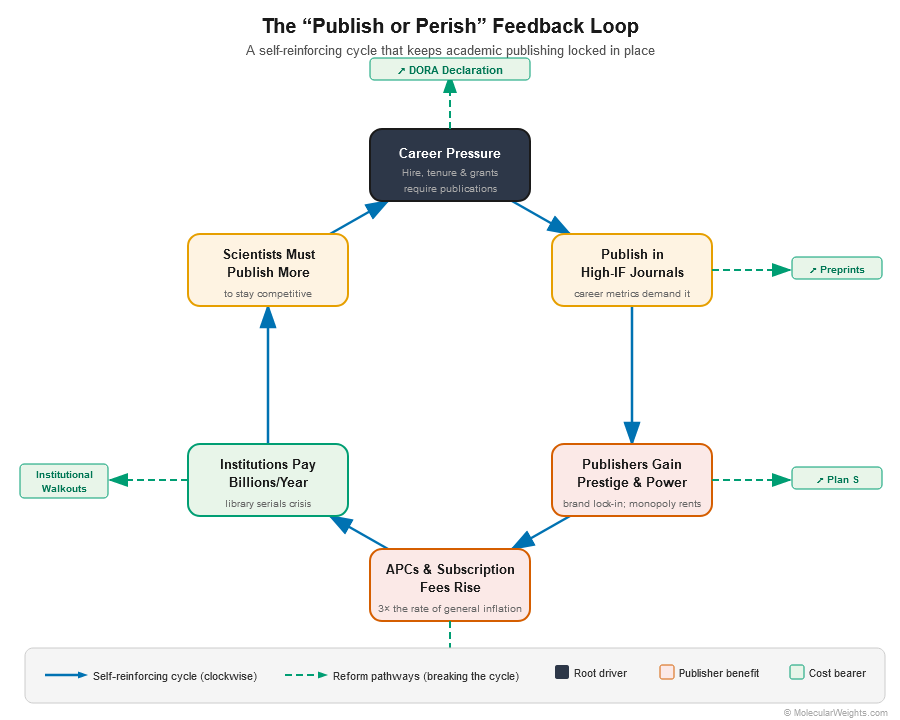
Figure 1: The Publish-or-Perish Feedback Loop. The self-reinforcing cycle that locks academic publishing in place. Researchers must publish in high-IF journals to advance careers. Publishers set the criteria for prestige. Universities pay fees to maintain access. Federal funding supports the researchers producing the content. Each arrow represents a dependency that makes unilateral exit nearly impossible. © MolecularWeights.com
Part 9: The Humanities vs. The Sciences
Publishing economics are sharpest in STEM fields, but the humanities have their own version of the problem. In some ways, their crisis is worse.
Sciences: The APC Burden
In the natural sciences and medicine, the primary cost is the author fee (APC). A chemistry research group publishing 10 papers per year can spend $60,000 to $150,000 on these fees alone. This line item competes directly with salary and equipment budgets. Early-career researchers without large grants often cannot afford high-impact fees at all. This structurally disadvantages them relative to well-funded labs.
Humanities: The Monograph Crisis
In the humanities, prestige hinges on the peer-reviewed monograph (book). A tenure case often requires a book published by a prestigious university press.
University presses are nonprofits. They have been squeezed by the same library budget cuts that hit journal publishers. However, they cannot raise prices the same way commercial publishers do. The result is that university presses publish fewer books. Academic books routinely sell only 200 to 400 copies at prices of $100 or more.
The library budget cut becomes self-reinforcing. Libraries cannot afford books, so presses sell fewer. Presses become less viable and publish less. Humanities scholars then struggle to establish tenure cases.
Different Fields, Same Extraction Logic
The table below shows how publishing economics vary across fields:
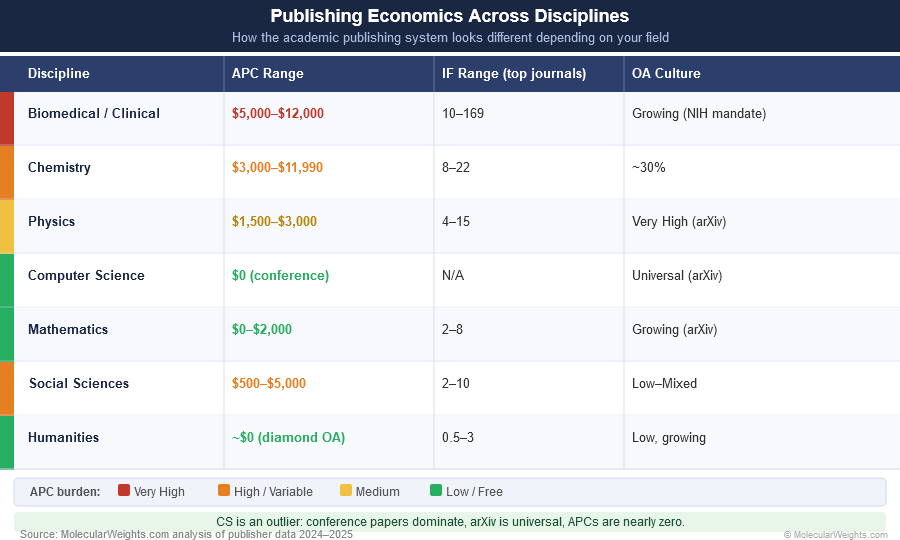
Table 1: Publishing economics across academic disciplines. Left color stripe indicates APC cost burden: red = very high, orange = high, yellow = medium, green = low or free. Computer Science is a structural outlier. Conference preprints on arXiv make most CS research freely accessible at near-zero APC cost. © MolecularWeights.com
Part 10: Can This Change?
Change will likely be slow. It will require sustained external pressure.
The lock-in is structural. Researchers need journal publications. Journals need prestigious reputations. Reputation accrues over decades. Starting a new journal means starting a prestige clock from zero. No junior researcher can afford to publish in a venue with no prestige.
What Is Actually Working
Preprints have normalized sharing before peer review in many fields. The norm is not universal, but it is growing.
Funder mandates are the most powerful lever. The US OSTP mandate and European Plan S cover hundreds of thousands of papers. Publishers will adapt, but they will try to preserve revenue through author fees or new agreements.
Mass journal resignations happen periodically. When an entire editorial board defects and starts a competing open-access journal, the publisher loses both content and legitimacy.
Subscribe-to-Open (S2O) is an emerging model. Libraries pay their usual subscription fee, and the publisher makes all content open access as a result.
What Would Actually Fix It
Hiring and tenure committees must evaluate the work itself rather than the journal. If the evaluation of careers decouples from journal prestige, the leverage publishers hold collapses.
Peer review should be visible and compensated. If reviewer contributions were credited and recognized, the free labor that underpins publisher profitability would have a cost.
Funding should support diamond OA infrastructure. The technology to run high-quality publication costs a fraction of what universities currently pay. The money is already there, but it flows to shareholders instead of infrastructure.
Conclusion: The System Works, and That Is the Problem
The academic publishing system is a genuinely impressive piece of organizational design. The historical process that produced it managed to build a structure where the same labor that creates the product also validates it. The people doing that labor cannot opt out because their careers depend on the prestige that flows from the journals extracting their work.
It is not malicious. Scientists are doing work they care about. The publishers are not cartoonish villains. They run real businesses that provide genuine services. However, the incentive structure and the profit margins are hard to justify. Most underlying research was funded by the public, yet the public cannot read the results without paying a fee.
Pressure is real and growing. Preprints, funder mandates, and campus resistance are all making cracks in the walls. The scientific record belongs to science. Getting it back may take as long as building the system that captured it.
Did You Know?
· The University of California’s 10-campus system cancelled its Elsevier subscription entirely in 2019. This move would have been unthinkable a decade earlier.
· In computer science, the top venues are conferences rather than journals. Nearly all papers go onto arXiv for free on the day they are submitted. An entire field’s prestige structure can be built on open access.
· “Predatory journals” now number in the tens of thousands. They charge author fees and perform no real peer review. They exist because the pressure to publish is intense enough that some researchers will pay to avoid scrutiny.
References
Larivière V, Haustein S, Mongeon P (2015). The oligopoly of academic publishers in the digital era. PLOS ONE 10(6):e0127502. doi:10.1371/journal.pone.0127502
Aczél B, Szaszi B, Holcombe AO (2021). A billion-dollar donation: estimating the cost of researchers’ time spent on peer review. Research Integrity and Peer Review 6:14. doi:10.1186/s41073-021-00118-2
RELX Group (2022). Annual Report and Financial Statements 2022. relx.com
Bergstrom CT, Bergstrom TC (2004). The costs and benefits of library site licenses to academic journals. PNAS 101(3):897-902. doi:10.1073/pnas.0305628101
Abdill RJ, Blekhman R (2019). Tracking the popularity and outcomes of all bioRxiv preprints. eLife 8:e45133. doi:10.7554/eLife.45133
Ding W, Hou J, Li J, Guo C, Qin J, Kozma R, Wang FY (2022). DeSci based on Web3 and DAO: A comprehensive overview and reference model. IEEE Transactions on Computational Social Systems 9(5):1563–1573. doi:10.1109/TCSS.2022.3204745
Tenorio-Fornés A, Pérez Tirador E, Sánchez-Ruiz AA, Hassan S (2021). Decentralizing science: Towards an interoperable open peer review ecosystem using blockchain. Information Processing & Management 58(6):102724. doi:10.1016/j.ipm.2021.102724
Weidener L, Spreckelsen C (2024). Decentralized science (DeSci): definition, shared values, and guiding principles. Frontiers in Blockchain 7:1375763. doi:10.3389/fbloc.2024.1375763